
What is Finance and Financial Management?
Finance is a broad term that describes activities associated with banking, leverage or debt, credit, capital markets, money, and investments. Finance also encompasses the oversight, creation, and study of money, banking, credit, investments, assets, and liabilities that make up financial systems.
Finance is the elixir that assists in the formation of new businesses, and allows businesses to take advantage of opportunities to grow, employ local workers and in turn support other businesses and local, state and federal government through the remittance of income taxes.
Financial Management means planning, organizing, directing and controlling the financial activities such as procurement and utilization of funds and enterprise. It means applying general management principles to financial resources of the enterprise.
Organization Structure
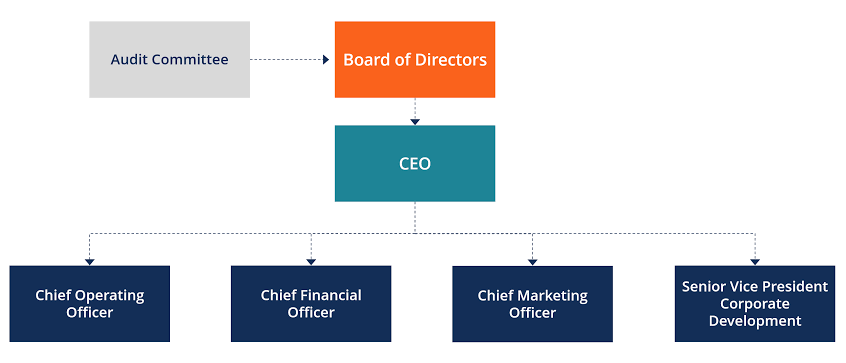
Organization Structure is a system that outlines how certain activities are directed in order to achieve the goals of an organization. These activities can include rules, roles, and responsibilities. The organization structure also determines how information flows between levels within the company.
Organizational structure provides guidance to all employees by laying out the official reporting relationship that govern the workflow of the company. A formal outline of a company’s structure makes it easier to add new positions in the company, as well, providing flexible and ready means for growth.
The roles of each position identified.
1. SHAREHOLDERS – elect the Board of Directors (BOD). Each share held is equal to one voting right. Since the shareholders elect the BOD, their responsibility is to carry out the objectives of the shareholders. Otherwise, they would not be elected in that position.
2. BOARD OF DIRECTORS – is the highest policy making body in a corporation. The board’s primary responsibility is to ensure that the corporation is operating to serve the best interest of the stockholders.
The following are among the responsibilities of the board of directors:
- Setting policies on the investments, capital structure and dividend policies.
- Approving company’s strategies, goals and budgets.
- Appointing and removing members of the top management including the president.
- Determining top management’s compensation.
- Approving the information and other disclosures reported in the financial statements (Cayanan, 2015)
3. PRESIDENT (Chief Executive Officer) – the roles of a president in a corporation may vary from one company to another.
Among the responsibilities of a president following:
- Approving the information and other disclosures reported in the financial statements. Overseeing the operations of the company and ensuring that the strategies are approved by the board are implemented as planned.
- Performing all areas of management: planning, organizing, staffing, directing and controlling.
- Representing the company in professional, social, and civic activities.
4. VP FOR MARKETING
- Formulating marketing strategies and plans. Directing and coordinating company sales.
- Performing market and competitor analysis.
- Analyzing and evaluating the effectiveness and cost of marketing methods applied.
- Conducting or directing research that will allow the company identify new marketing opportunities e.g. variants of the existing products/services already offered in the market.
- Promoting good relationship with the customer and distributors. (Cayanan, 2015)
5. VP FOR PRODUCTION
- Ensuring production meets customer demands.
- Identifying production technology/process that minimizes production cost and make the company cost competitive.
- Coming up with a production plan that maximizes the utilization of the company’s production facilities.
- Identifying adequate and cheap raw material suppliers. (Cayanan,2015)
6. VP FOR ADMINISTRATION
- Coordinating the functions of administration, finance, and marketing departments.
- Assisting other departments in hiring employees.
- Providing assistance in payroll preparation, payment of vendors, and collections of receivables.
- Determining the location and maximum amount of office space needed by the company. Identifying means, processes, or systems, that will minimize the operating costs of the company (Cayanan, 2015)
The role of the VP for Finance/Financial Management is to determine the appropriate capital structure of the company. Capital structure refers to how much of your total assets financed by debt and how much is financed by equity.
To be able to acquire assets, our funds must have come somewhere. If it has bought using cash from our pockets, it has financed by equity. On the other hand, if we used money from our belongings, the asset bought has financed by debt.
 Introduction to Financial Management